What Is Stage Fright
Stage fright affects performers at every level. Here's what's actually happening in your body, why it hits singers so hard, and how to start breaking the cycle.
Laura Dumbleton
5/15/20264 min read
We've all heard the term 'stage fright', but what does it actually mean? Because it's used to describe everything from mild pre-show butterflies to completely freezing on stage, and those are very different things.
The clinical term is music performance anxiety, and the research defines it like this:
"The experience of marked and persistent anxious apprehension related to musical performance [and is] manifested through combinations of symptoms... It affects musicians across the lifespan and is at least partially independent of years of training, practice, and level of musical accomplishment."
Kenny, D.T. (2009). The Role of Negative Emotions in Performance Anxiety. Handbook of Music and Emotion. Oxford University Press.
Oooooft, science alert! Let's unpick that.
What Kenny is telling us is that performance anxiety can affect any musician, at any stage of their career, regardless of how much they've practised or how experienced they are. It's not a beginner problem. It's not a confidence problem. And it's not a ‘you haven’t practised enough’ problem.
So what's actually going on?
Stage fright is a nervous system response. When your brain perceives a threat, it activates the fight-or-flight response. Adrenaline surges, your heart rate climbs, your muscles tense and the breath goes shallow. All of which we perceive as negative.
For early humans in the hunter-gatherer days, that adrenaline surge was the thing that kept you alive - if a man-eating tiger appeared, we needed to have the energy and strength to either get away from it or fight it.
Despite evolution, the threats are different these days. Maybe it’s a performance that could go wrong, an audition that you might not be cast from, a less-than-warm audience. The key thing is that your brain can't always tell the difference between physical danger and social danger, so it responds the same way. Activating the fight or flight response.
This all means that your body isn't sabotaging you. It's trying to help. It's just that the response designed for outrunning predators is not particularly useful when you're trying to sing.
Why it hits singers particularly hard
Most performers deal with nerves. It comes as part of the territory, as musicians we are showing our most vulnerable selves to people for judgement. But we just call it performance!
As musicians, singers have a specific challenge that instrumentalists don't: your instrument is inside your body, and your nervous system affects it directly.
Experiencing activation of any kind – good and bad stress! – can cause a variety of symptoms to show up. For example, anxiety tightens the muscles around the larynx. Nerves can make the breath become shallow and unreliable. Holding back on something makes the body tense.
These are things you'd perhaps barely notice in everyday life, but when you’re singing, when everything depends on freedom and flow, you feel every single one of them.
And then we add in visibility – singers don’t have anything to hide behind or blame when things go wrong. An instrumentalist has an instrument between them and the audience, a singer has maybe a mic stand or music stand. And when something goes wrong, it’s very hard to separate that from a personal problem.
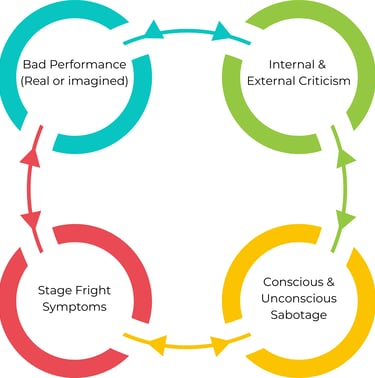
The cycle that keeps it going
Wherever you are in the cycle, it keeps going. Because it’s built to feed on itself, and it does! But the good news is that the cycle always has a weak point. If you break one link in the chain, the whole cycle weakens. If you keep breaking that link, the cycle eventually breaks.
Yes, you read that right. The whole cycle can eventually break when you feed it enough evidence to the contrary.
What doesn't help (and why)
I have heard a LOT of advice that teachers give to singers who have stage fright. And honestly, most of it won’t work long-term because it’s not deep enough to break one of the links in the chain.
"Just practise more."
Yes, preparation matters, yes you need to know your stuff. But if the problem is a nervous system response, more repetitions of the logic or technique won't fix it. And over-preparing can actually reinforce the belief that you're never quite ready.
"Visualise a positive outcome."
If you are rooted in fear, a positive outcome can feel impossible. You can’t think your way out of a physiological activation. When paired with the senses, this might work, but only in some cases.
"Pretend the audience are only wearing underwear”
One of the worst pieces of advice. Yes, they are humans too. But they are not going through the same thing you are right now. Visualising them in their underwear is not going to help.
"Fake it till you make it."
Sometimes helpful, but briefly. Pretending you are confident works to a certain extent and might work better for people who were allowed to play dressing up as a child. But it can add a layer of masking that many performers are not comfortable with, and it can make things worse over time.
All of these suggestions address the surface level of the problem, not the underlying issues. And stage fright operates at the level of feeling, so we need to go there to effectively break the cycle.
What actually shifts things
Working with stage fright effectively means working at the level of the nervous system. That means understanding your own patterns, triggers, feelings and how to work with them when they are activated.
It means having practical, body and brain-based tools that work before you go on stage and in the room itself. Breathwork techniques, physical regulation, mental regulation, essentially a toolbox of ways to shift your nervous system state quickly. Not generic 'just breathe' advice, but specific tools that actually work.
And it often means looking at the story underneath the anxiety. What does this performance mean to you? What do you believe is at stake? That layer is worth examining, because it's usually where the cycle started.
Want to break your stage fright cycle?
I work with singers and performers who know their material but find their nerves getting in the way. If that sounds familiar, let's talk.
A discovery call is a good place to start. We'll look at what's happening for you specifically, and I can give you a sense of what working on this together might look like.